


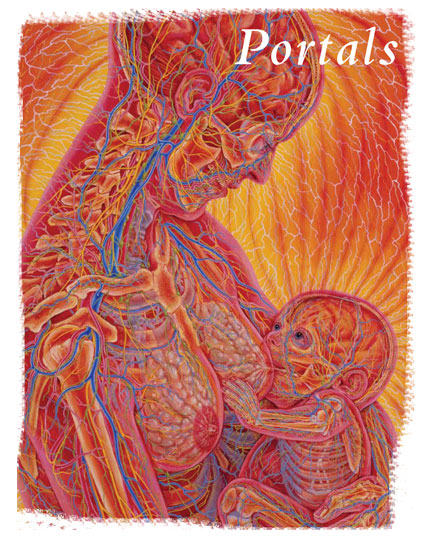


Sitting in the Wild Heart
“For it is not too early to see the practice of an art… as one of the “Ways,” in the Oriental sense of the word, namely as one of those disciplines… by which one may attain one’s own Truth, as do meditation and prayer… “Yogas” they are that bring us in direct touch with the very structure of life.”
—Frederick Franck, Art As A Way
There is a tradition of inwardness in spiritual life that at first seems to be directly opposite to the outward expressions normally associated with creativity and the arts. The contemplative life offers a deep silence and interior stillness borne of meditation, prayer, ritual and religious practices. The life of creative expression, on the other hand, involves love songs, wild dances, spontaneous poems, and visionary paintings; shooting photos, throwing pots, performing Lear, and serving Japanese tea. Yet again and again on the pages of the Wild Heart Journal, in conversation with people who are both artists as well as spiritual practitioners, a meeting place was revealed: clearly, inner spiritual realization effortlessly expresses itself in outward creative forms; not as obvious, but equally true, the creative process can be approached as a practice, or a “Way,” that can serve as a catalyst for personal transformation and spiritual unfolding.
Certainly the deeper one’s inner life, the more substantive one’s creative expression — from a rich well of silence and stillness, a truer song and movement emerge. Any activity which deepens or clarifies the “who” we are, automatically enriches and infuses the “what” we create and express. Mystical, visionary art is a person-to-person, direct communication between the “who” of the artist and the “who” of the viewer, such that a recognition and a meeting occur. The creation itself, whether novel, ballet or watercolor, is merely a connecting device, like a telephone line. The transmission is from heart-to-art-to-heart. It could be argued that all creative output is such a conversation. But works that arise from a mystical orientation have a specific intent that is generally not at all the intention of many mainstream creative productions. And that is:
- To generate a conscious awareness of the utter mystery of existence.
- To awaken and inspire, and transport one out of the everyday mind of limitation into the limitless domain of Being.
- To transmit spiritual realities in a way that bypasses the skeptical mind and dazzles the heart with awe and wonder, color, shape and movement, torch songs and tap dances.
- In short, the art of the mystic is intended to be transformational, a communication of the awakened, transcendent reality.
But how about the other direction? In what way do creative practices function not merely as expressions of one’s spiritual life, but as actual paths toward growth, evolution, and personal transformation? Does writing, for example, even “count” as a spiritual activity? Obviously not just any writing, or Barnes & Noble would be the archives of the enlightened. But can writing be approached in a way that converts it to a transformational practice? The answer is a resounding “Yes!” and in the Wild Heart interviews the same is affirmed for dance, painting, music, singing, pottery, theater, poetry, photography, tea ceremony, even running a corporation! The form is not so important; one can indeed hit the Zen target of awakening through the discipline of archery as well as by sitting for years in zazen.
What is important is the context in which the form is enacted. Anything and everything can and does function as a “Way” when one approaches it as a spiritual practice, whether it be motorcycle maintenance, needlepoint or parenting. Ruth Zaporah said it best when we spoke with her: “I would say I used to have a spiritual practice. Now I’m just living.”
For in the context of spiritual awakening, each and every moment is the be all and end all of existence. This moment is truly “it.” When there is no future moment we’re waiting for when “everything will be better and different”— when we really know in our gut that such a destiny is not hurtling its way towards us — we are propelled into the living moment with a fullness of Presence and Being that declares this present moment to be our Destiny, and it is at once completely ordinary and totally sublime. And so in this context, all of our actions, from playing jazz guitar to driving to work, are “practice” — moments in which to simply be present because there is no other time or place to be. Showing up is everything.
So the distinction between what is spiritual practice and what is simply living eventually drops away. All Ways, in fact, are programmed to self-destruct, for if they work they will guide us to the place in consciousness where we are always already a transcendent witness to the apparently separate, troubled ego that felt the need to embark on a path in the first place! The one who adopts a Way to get somewhere eventually arrives in the Fullness of Divine Presence, here and now, where there is no urgency about getting anywhere, and therefore no need for a path. There is, finally, only This. And to be an “Artist of Being” is to sit quietly within This — the Presence of Infinite Mystery — and enjoy what can often be simultaneously a wildly expressive heart.
“I know artists whose medium is life itself, and who express the inexpressible without brush, pencil, chisel or guitar. They neither paint nor dance. Their medium is Being. Whatever their hand touches has increased life… they are the artists of being alive.”
— Frederick Franck
In the 1990s, my friend Michael Freeman and I conducted a unique experiment. We ran several 7-day retreats, entitled “Sitting in the Wild Heart,” in which participants explored the polar opposites of inner work and outer expression. In a context of a silent, Buddhist meditation retreat — with Michael serving as our resident Dharma teacher participants moved gently from sitting and walking meditation into cathartic dance, passionate song, writing and reading ecstatic poetry, making outrageous paintings. And then back into silence and sitting, walking and eating in the contemplative mode of solitude and stillness.
Michael‘s principal intention as a teacher was to communicate the state of mindfulness, being simply present and aware of all one’s sensations, thoughts, experience. It requires much discipline, patience, will power and attentiveness, and has nothing less than liberation and enlightenment as its goal.
Those of us who meditate usually at one time have had a flash of expanded vision that hooked us, an intimation of a vast emptiness at the heart of our own increasingly mysterious consciousness. To dwell in that place and rest there, rather than merely being teased by such glimpses, is the hope we place on our meditation cushion. Even though all the teachings — especially Zen — couch the meditation practice in the context of “there is nowhere to go, nothing to attain, let go of all striving, simply be present” — we nevertheless strive for that. We strive to be free of striving.
Mindfulness practice reveals that in the present moment, say, of eating, there is only this hand, lifting this spoon, bringing it towards this mouth; and in this moment, there is tasting, and in this one, swallowing. Or in walking, one foot lifts as the other moves forward, the breath moves in and out, and in the careful noticing of these events, one can settle into an easeful, joyful, moment-by-moment experience of simply “being with” whatever is occurring, including internal mental and emotional activity. There is never anything to fix or change. All is observed dispassionately. Enlightenment is lived in the here and now as simple Presence.
In a complementary manner, the expressive arts offer continuous opportunities to leap out of the mind into the fullness of Presence in the Now. Creativity gives us a chance to step out of time, out of our unfolding storyline,into This Present Moment of putting word to paper, applying paint to canvas, leaping and spinning through space. In order to be fully present in a creative act, we have to let go completely, if momentarily, of our self-conscious thinking mind. For we cannot think our way out of thought; we can only leap out of our minds, and the arts are ideal for providing opportunities to leap.
Is this fundamentally a different state than “being aware my hand is holding the spoon”? Do I “know” I am singing when I am fully in it, or has even that witness aspect of the knower had to step aside in order to let the song out? Michael and I debated this endlessly, pondering how one could remain mindful on the one hand, as he taught, and be completely mindless on the other, which was my principle instruction–to dance and sing freely, with total abandon, with nothing left over to even ask the question of “Am I being mindful?” While we batted this back and forth, arguing for our “side,” the retreatants meanwhile simply moved through the daily schedule with ease and delight, from half a day of sitting practice to playing with watercolors. From meditation to dance back to sitting then to song or poetry. And there was no conflict. It made perfect sense to the actual persons having the experience, even if in the leaders’ minds there appeared to be something important to sort out philosophically. In the domain of Being, sitting in silent meditation and engaging in wild and free creative expression seemed to be a perfect pairing that followed an inner, experiential logic of its own.
All the conversations and articles in this book are about one subject: this meeting place where the rivers of Art & Spirit merge, which is none other than Love. The spiritual/creative journey has a single goal: to awaken us as lovers in the midst of Divine Mystery, and when we express that love and mystery in form and beauty, we are each of us mystical artists.
As the 14th Century Sufi poet, Hafiz, put it:
The subject tonight is love
And for tomorrow night as well.
As a matter of fact,
I know of no better topic
For us to discuss
Until we all
Die!

