


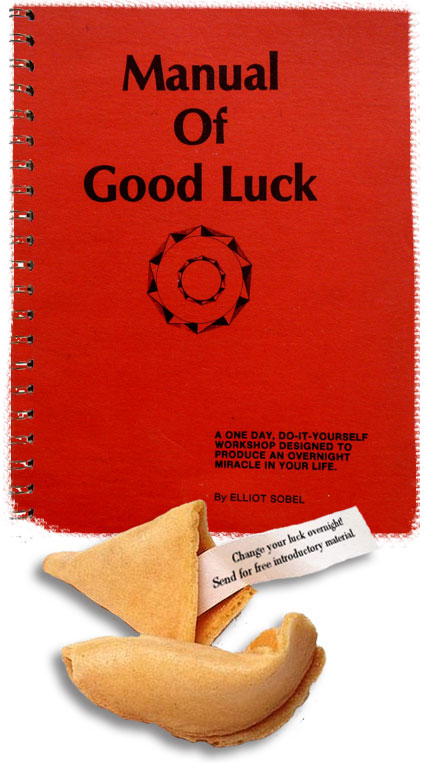


I was actually not at all well versed in the Ancient Secrets of the Essenes, so I dropped that idea, and to produce the manual, I sequestered myself in a Tibetan Buddhist Monastery in Woodstock, New York for seven days. I spent the first three days in writer's agony, crumpling page after page. And then I hit on it: I would create the home-game version of the est training — the original and controversial crash consciousness course of that era, which I had experienced and thoroughly enjoyed, despite all the negative press it received.
In a combination of heartfelt intentions, naivete and arrogance, I believed myself as enlightened as the next guy, and decided to convey my new-found insight into the human condition through an experiential, do-it-yourself, at home workshop. I had in mind all those people — particularly my own family — who I thought would benefit greatly from a program like est but whom I knew would never do it.
The book began by asking readers to set aside a full day of their lives— in solitude, away from people and phones — in order to create an experiential workshop for themselves, orchestrated moment by moment by me. Once I had their undivided attention, I proceeded to tell them everything I knew about life.
As of 1987, the Manual of Good Luck had sold over 40,000 copies, and was still selling. I received only our agreed-upon flat fee of one thousand dollars. It never occurred to me to negotiate for a percentage. A thousand dollars seemed like a good deal to me then. It was an 8 1/2 x 11 workbook, so for fun, I ripped off the cover and submitted it as a manuscript to Spectrum Books, a division of Prentice Hall. They promptly sent me a contract. At which point I had to sheepishly confess that there was one slight hitch: I didn’t own the rights to my own manuscript. I attempted to negotiate with the Manual’s owner and publisher to buy back the copyright, but to no avail. I had to let it go. I thought about rewriting it enough to submit as a new work, and this eventually led, in 1994, to Wild Heart Dancing , an entirely different book, but which borrowed the take-a-day-off-from-your-life idea for a guided self-retreat.
A friend once calculated that the publisher of the Manual of Good Luck may well have made close to half a million dollars or more on my work, and she said that I had nothing to lose by writing him and simply requesting $25,000. So I did.
She was right: I lost nothing.
Interestingly, just a few years ago, out of the blue, a stranger tracked me down through e-mail, desperately trying to get hold of the Manual of Good Luck. It seems her daughter had discovered a copy of it in the Peace Corps library in Ethiopia, and it had changed her life. I sent her one of the six remaining copies that I kept in a box. Her relatives and friends soon bought up the rest.
I later discovered a pamphlet for sale on the internet called Manual of Good Luck. Suspicious, I ordered it for $10, and sure enough, discovered my own words — including parts of my own life story — attributed to a name I didn’t recognize as my own. My work had been edited from the original 175 pages down to a flimsy, ten-page pamphlet. I successfully put the fear of God into the man responsible and he stopped selling it.

